Admin posted: " It's a common scenario: You've spent endless hours in your home studio, painstakingly polishing your sonic masterpiece to perfection. But then, when you play that finished product away from your workstation—on speakers in another room, on "
It's a common scenario: You've spent endless hours in your home studio, painstakingly polishing your sonic masterpiece to perfection. But then, when you play that finished product away from your workstation—on speakers in another room, on your car stereo, on headphones—it suddenly sounds very different. Maybe it's shrill, maybe it's boomy, maybe you can barely pick out the lead vocal. No, you're not imagining things, but you might be surprised to learn that the problem is probably the result of mixing on inaccurate speakers. That's why you should upgrade your studio monitors. Unlike hi-fi speakers, which tend to "flatter" sound by enhancing lows and highs to provide a pleasing listening experience, the best studio monitors are designed to reproduce sound exactly as intended—warts and all—so you can make informed decisions about your mix without being influenced by sonically hyped speakers.
It's the audio equivalent of viewing the world through a clear window versus stained glass: Stained glass creates gorgeous colors and patterns, but sometimes you just need to see what's on the other side, even if it's ugly out there. Let's peer at some top choices to bring this clarity home.
How we selected the best studio monitors
With hundreds of choices out there, we focused on the best studio monitors that balance proven performance, value, and universal appeal. All of the brands here make a wide range of professional recording products; you'll find their production tools in just about every recording studio. The monitors we profile here represent the culmination of decades of audio research and testing. They've been established in the market for years, have earned the stamp of approval from pros we've consulted, and we like them, too.
What to consider when searching for the studio monitors
Above all, studio monitors need to be honest and accurate. It's easy to be tricked by speakers that have a signature "sound." Imagine that you're listening on a very bright system: You think you hear too much treble in your mix, so you cut the highs. But when you play that same mix on a balanced system, it sounds murky and muddy. Or, let's say you're creating club mixes on a bass-heavy system. Things sound boomy, so you dial back the low end. But when you take that same mix to the venue, it sounds like it's playing out of a tin can. Other monitor considerations depend on the style of content you're creating, the size of the space you're working in, and your room acoustics.
Match your studio speakers to the size of your space
Generally speaking, the bigger the monitor, the more power it can put out, and the deeper the bass it can produce. In the case of studio monitors, however, more isn't always better. You want monitors that are small enough to operate efficiently in your space; if your monitors are too powerful for the size of the room, you can't run them at their optimal levels and they can sound boomy. On the other hand, your monitors need to be robust enough to effortlessly reproduce your most dynamic content. Generally, monitors with 5- to 8-inch drivers are good fits for home studios.
Assess your room acoustics
Speakers interact with the space they're in. If your room has a lot of acoustic anomalies, it can color the sound of your monitors. Some speakers are designed to sound great without any adjustments—for example, they might be acoustically optimized to sit on a desktop. Other monitors feature built-in signal processing designed to minimize the influence of your space; some speakers can even self-adjust to compensate for room problems. While these features can be helpful, they're not miracle workers and even the best speakers can't make up for uncontrolled acoustics. If you're serious about choosing the right monitor, you should be serious about taming the sound in your space—like soundproofing.
Consider your content
Choose a monitor size that complements the type of content you create. Are you a podcaster or into acoustic music? Five-inch speakers might be fine for you. Are you a DJ or EDM producer, making music that will end up in a club? You might want to consider bigger monitors that deliver deeper bass.
When to add a subwoofer
Sometimes it makes sense to bring in a subwoofer to extend the low-end range of your system. This can be very revealing if you have smaller monitors or you're producing bass-heavy dance or hip-hop tracks. Note that low-end sound waves travel right through the walls of home studios—something to consider if you're trying to keep the neighbors happy. You can certainly mix and match speakers and subs, but most of the product lines here feature subwoofers—including ones from Yamaha, JBL, KRK, and Mackie—that are designed to pair with monitors in the series.
The best studio monitors: Reviews & Recommendations
Wading through the options can be daunting. We've made it a little easier with our favorite picks for a variety of content creators, from podcasters to EDM producers to mixers on the go. All of our choices are self-powered studio monitors, meaning you won't need a separate amplifier. With models starting at $99, there are bound to be monitor speakers that fit your budget. Oh, and often pro studio speakers are sold as singles, so don't forget to pick up a pair!
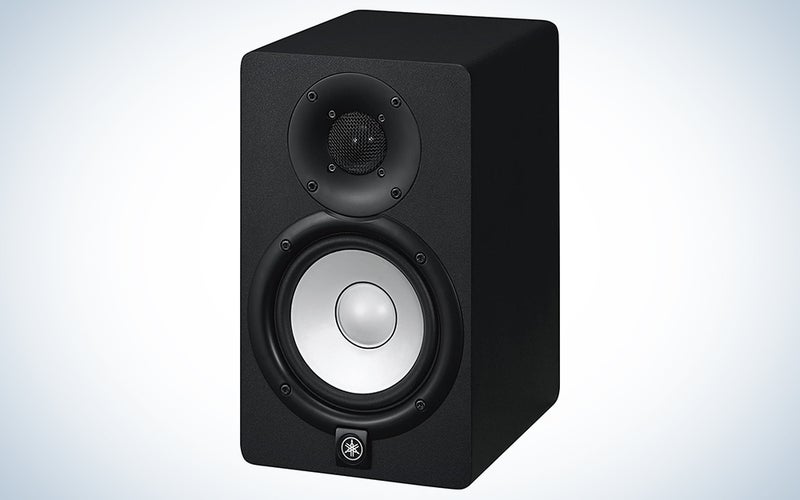
Best studio monitors for old-school truth seekers: Yamaha HS5
Why it made the cut: When you buy Yamaha studio monitors, you're buying in to decades of R&D and experience producing some of the most neutral speakers in the industry.
Specs:
Frequency response: 54 Hz-30 kHz
Max SPL: 90 dB
Power rating: 70W
I/O: 1 XLR, 1 TRS
Dimensions: 11.2 x 6.7 x 8.7 inches (HxWxD)
Weight: 11.7 lbs.
Pros
Cons
Precise stereo imaging
Built-in filters and level control
Accurate, pro-proven mix translation
No cables included
Built-in filters and level control
Narrow listening sweet spot
Since the 1970s, Yamaha's iconic black NS10 studio monitors with their iconic white woofers have been recording studio standards, thanks to their unforgiving sonic accuracy. The HS Series, an evolution of that line, shares that same focus on transparency and achieves a smooth response over a wide frequency range. Speakers are available in sizes ranging from 5-inch to 8-inch drivers and come in black and white finishes. The HS5, profiled here, is one of the most popular models for home studios.
The HS5 is a bi-amplified nearfield studio monitor with 5-inch cone woofer and 1-inch dome tweeter that deliver well-defined bottom end for its size, with clear and accurate mids and precise highs. The cabinet features three-way mitre joints, which eliminate resonances and improve durability. Built-in Room Control and High Trim Response functions help the HS5s compensate for unruly room acoustics. The HS5 offers a somewhat narrow listening sweet spot, which means you'll need to pay extra attention to the locations of your speakers and listening position. But once you get it right, you'll start hearing elements of your mix that you never noticed before—for better or worse. Tough love, indeed.
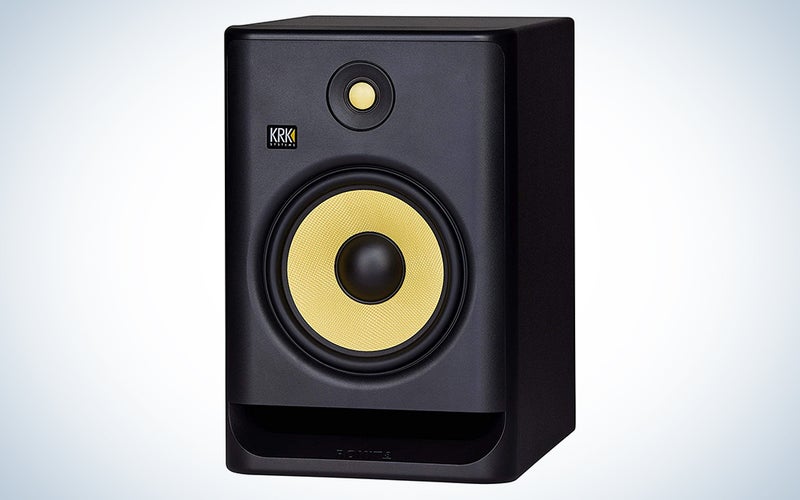
Best studio monitors for DJ/producers: KRK ROKIT 8
Why it made the cut: This fourth-generation icon is favored by home producers for its deep, definitive bass and room-correcting DSP.
Specs:
Frequency response: 36 Hz-40 kHz
Max SPL: 111 dB
Power rating: 203W
I/O: 1 XLR-1/4-inch combo
Dimensions: 15.8 by 10.5 by 12.2 inches (HxWxD)
Weight: 45.2 lbs./pair
Pros
Cons
Powerful, punchy bass
DSP can be complicated for novices
Built-in room-tuning DSP with free app
Bass-forward signature is not ideal for all genres
Acoustic pads on bottom help with decoupling
Heavy
Chances are you've seen KRK Rokits, with their iconic yellow cones, gracing YouTube videos and Instagram posts by your favorite producers. These legendary monitors, now in their fourth generation, are pro favorites thanks to their solid build quality, natural sound, and built-in room-correcting signal processing. Rokits are particularly beloved by DJ and EDM producers because of their deep, full bass response. Rokit G4s feature two-way, bi-amped designs and are available in 5-inch, 7-inch, 8-inch, and 10-inch versions; here, we're focusing on the 8-inch Rokit 8.
The Rokit 8's 8-inch Kevlar woofer and 1-inch dome tweeter reproduce sound over a broad frequency range of 36 Hz–40 kHz, and its ultra-efficient Class D amplification ensures powerful, clean sound at any volume. An optimized high-frequency waveguide provides precise imaging and a wide listening sweet spot, and a low-resonance, ported enclosure delivers enhanced bass performance. The Rokit line's bass-forward signature might not be ideal for every genre of music, but if you're creating club bangers, it'll bring you closer to the sonic experience of DJing in the venue.
Rokit 8 offers built-in digital signal processing including EQ, signal generators, analyzers, and speaker-placement tools. Make adjustments using the speaker's built-in LCD or with KRK's free app for iPhone or Android. All Rokits include acoustic isolation pads that help dampen monitor vibrations.
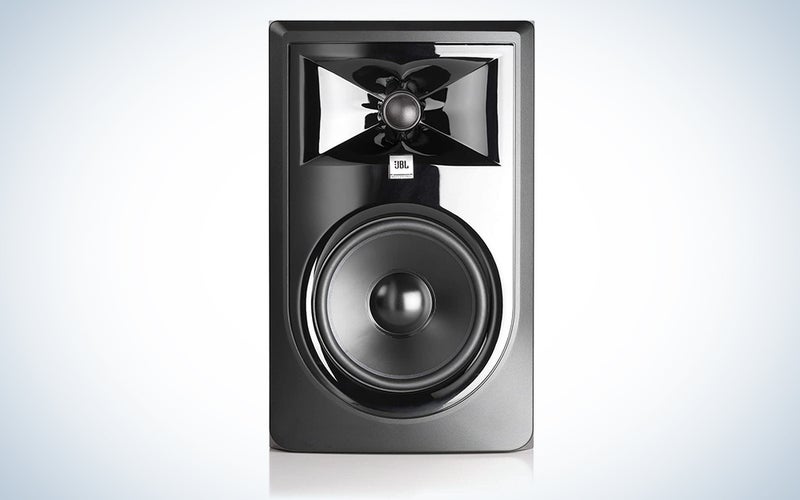
Why it made the cut: Borrowing design innovations from JBL's higher-end studio monitor lines, the LSR 305P MKII brings professional technologies to an accessible price for home studios.
Specs:
Frequency response: 43 Hz-24 kHz
Max SPL: 108 dB
Power rating: 82W
I/O: 1 XLR, 1 TRS
Dimensions: 11.75 x 7.3 x 9.9 inches (HxWxD)
Weight: 10.43 lbs.
Pros
Cons
Wide soundscape
Glossy finish isn't for everyone
Broad listening sweet spot
Audio cables not included
Room-tuning features
JBL has been in the speaker business for 75 years, with hundreds of offerings for recording, touring, cinema, broadcast, and casual-listening scenarios. The 3 Series MkII is the company's midrange studio reference monitor line, with models ranging from 5-inch to 8-inch drivers. The best fit for most home recording studios is the LSR 305P, a bi-amplified monitor with a 5-woofer and 1-inch dome tweeter enclosed in an MDF cabinet with a black PVC finish and a slick injection-molded ABS front baffle (a white version is also available). The enclosure features JBL's rear-firing Slip Stream bass port design, which is engineered to produce accurate bass at low playback levels.
The highlight of this speaker, though, is JBL's patented Image Control Waveguide, adapted from JBL's top-line pro studio monitors. This bowtie-looking beveled panel housing the tweeter is designed to deliver a very wide stereo soundstage, precise imaging, and increased high-frequency detail. It also provides a broad sweet spot, which means you'll have more leeway to move around at your listening position and still experience an accurate soundstage. (The "LSR" in the name stands for Linear Spatial Reference, JBL's design process in which 72 measurements are taken in 360 degrees around the speaker to optimize its off-axis response, which is what you hear when you're out of a speaker's main line of fire.)
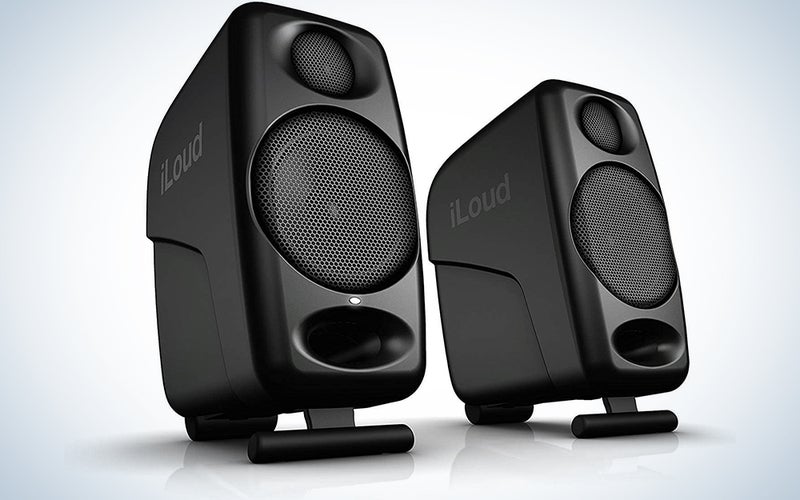
Why it made the cut: This small-and-mighty cousin of IK Multimedia's flagship iLoud will pack a punch in any portable rig.
Specs:
Frequency response: 54 Hz-30 kHz
Max SPL: 90 dB
Power rating: 70W
I/O: 1 XLR, 1 TRS
Dimensions: 11.2 x 6.7 x 8.7 inches (HxWxD)
Weight: 11.7 lbs.
Pros
Cons
Built-in DSP
Controls are all on rear panel
Bluetooth
No battery power option
Weighs less than 4 pounds
Limited bass by design
IK Multimedia hails from Modena, Italy, the birthplace of balsamic vinegar, so good taste is clearly at its core. The company got its start making software that emulates legendary recording studio equipment; its speaker line launched later with its now-classic iLoud monitor. The iLoud Micro Monitor, a spin-off of its larger, more expensive namesake, is touted as "the smallest active studio reference monitoring system in the world," and it's easy to see why: Unlike most speakers of this size, the iLoud Micro Monitor is designed to offer flat, neutral response without the hyped lows and highs you'll find in comparable consumer speakers.
IK Multimedia says the monitor is optimized for "makeshift spaces"—and because it's so small, you can sit closer to your speakers, minimizing the impact of bad room sound. It's based on a bi-amplified design featuring a 3-inch woofer and 3/4-inch silk dome tweeter in a ported enclosure for smooth, natural frequency response extending to 55 Hz. Internal 56-bit DSP handles room correction and optimizes driver performance. An integrated isolation base keeps your speakers from coupling with the surface they sit on. Use built-in Bluetooth for wireless casual listening; some engineers will also reference their mixes over Bluetooth to evaluate the lossy transmission's sonic impact. Not too shabby for a set of speakers clocking in at less than 4 pounds. Available in black and white.
Best studio monitors for budget-minded engineers: Mackie CR3-X
Why it made the cut: The most affordable studio monitor on this list, the full-featured Mackie CR3-X makes a great entry-level speaker or real-world reference.
Specs:
Frequency response: 70 Hz-20 kHz
Max SPL: 97 dB
Power rating: 50W (pair)
I/O: 2 x 1/4″ TRS, 1 x stereo RCA, 2 x push terminal, 1 x 1/8″/3.5 mm TRS in, 1 x 1/8″/3.5 mm TRS out
Dimensions: 8.1 by 5.5 by 7.1 inches (HxWxD)
Weight: 7.8 lbs./pair
Pros
Cons
Loud for its size
Bass distorts at moderate volume levels
Flexible inputs
No DSP/tuning
Includes workstation software and plug-ins
Distinctive visual design (though may be a pro, depending on user)
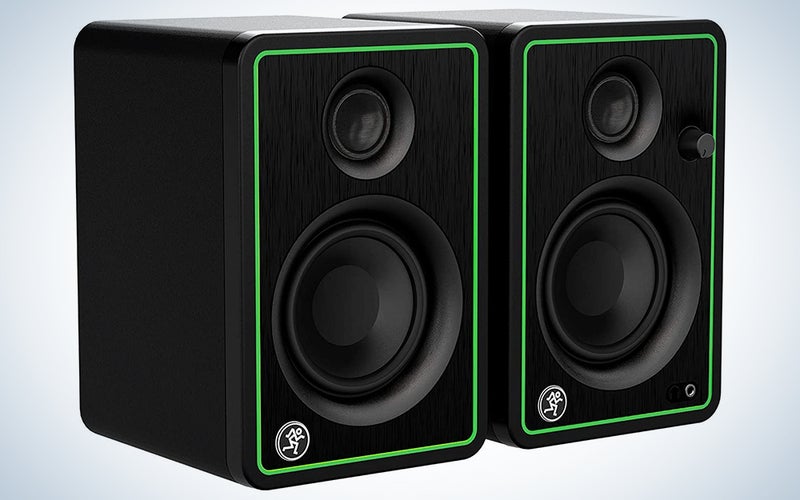
Mackie's CR Series Creative Reference Multimedia Monitor line is available in sizes from 3 to 8 inches, with available Bluetooth options. Here, we're looking at the 3-inch CR3-X, the only monitor in this roundup that retails for less than $100. The CR3-X has a solid build, striking looks, and offers clear, accurate audio for its small size and low price. Its solid MDF cabinet features a brushed-metal front panel with a distinctive lime-green trim that looks straight out of a "Tron" movie (Bluetooth models are available in white). The CR3-X comes in a pair comprising one passive speaker and one speaker containing a 50-watt power amplifier that drives both units.
Unlike the sea of sonically hyped speakers in this price range, the CR3-X is designed to present a clear, accurate sound signature, with a 0.75-inch silk-dome tweeter and 3-inch polypropylene-coated woofer providing full-bandwidth fidelity down to 70 Hz. The speaker is loud for its size, with a max SPL of 97 dB. The cabinet is rear-ported to help extend smooth low-end (this also means you shouldn't place the speakers flush against a wall). The speaker's low-end response is decent for its size, but you won't experience the detail necessary to make critical mix decisions in genres that emphasize big bass. For podcasts and YouTube videos, you'll probably be fine, but if you're looking for a little more thunder, Mackie offers the matching CR8S-XBT 200W sub with Bluetooth.
The CR3-X offers tons of I/Os: Rear-panel inputs include balanced 1/4-inch TRS and 1/8-inch stereo I/Os for connecting a variety of devices. A front-panel knob controls power and volume, and a convenient front-panel headphone output makes referencing on headphones fast and easy (plugging in headphones automatically disables speaker driver output). At $99, the CR3-X is already a very good value, and Mackie sweetens the deal by including a free copy of Pro Tools First and Mackie Musician Collection of 23 plug-ins and all of the cables you need to get a starter digital audio workstation up and running. It's a great entry-level studio monitor that can serve as a great "real-world" reference if you upgrade later.
FAQs
Q: What's the difference between studio monitors and regular speakers?
Studio monitors are designed to reproduce sound exactly as it was intended, which translates to a flat, neutral frequency response with no coloration. This is because production professionals want to hear exactly what they created so they can make informed mix decisions and root out sonic imperfections without being influenced by the "sound" of their speakers. Consumer bookshelf speakers, or "hi-fi speakers," are designed to provide a purely enjoyable listening experience and generally boost lows and highs (aka the "smiley" EQ curve) to make things sound bright and powerful. While it might be more fun to listen to music on consumer speakers, they're the sonic equivalent of rose-colored glasses and will cloud your judgment when you're evaluating mixes.
Q: Can I use just one studio monitor?
Yes and no. Modern music is in stereo, so you need two studio monitors to produce left and right stereo channels. If you're mixing for games, movies, and surround formats like Dolby Atmos, you'll need even more speakers. However, it's always a good idea to check your mixes in true mono on a single monitor to make sure your mix is spatially accurate when left and right signals are summed, like some people might hear it playing from a phone or compact Bluetooth speaker.
Q: Do you need a subwoofer with studio monitors?
Studio monitors come in many sizes to meet the needs of a range of spaces. Physics dictates that you need bigger drivers to recreate low-frequency sounds, which generate bigger sound waves than high-frequency sounds. And if you're working in EDM, rap, or hip hop, you'll need that extended low-end to hear everything in your mixes—particularly if you're working with 5-inch speakers. The great news is, most studio monitor lines include perfectly matched companion subs, which you can always add later on if you feel like your current setup isn't bringing enough thump and thunder.
The final word on choosing the best studio monitors
It doesn't matter how much you invest in condenser microphones and dazzling effects and other recording equipment if you can't hear a true, accurate representation of a vocal in the mix, etc. Besides your ears, your studio monitors are the most important part of your studio, the one constant and the lens through which you evaluate your work. More than other studio equipment, monitors are an investment in your craft, and using great studio monitors will help make you a better mix engineer. Choosing a monitor is a personal decision; there's no single model that's right for everyone. Ultimately, talent trumps technology and audio products are tools that serve your creative vision, which is what it's really all about.







No comments:
Post a Comment