[New post] Multilateral space: A European space oddity
Admin posted: " In 2021, Russia blew up one of its own satellites, producing 1,500 pieces of unpredictable orbital debris. The peculiarities of the space domain mean that even a weapons test such as this by a country against one of its own satellites could endanger o" Exclusive Global News
In 2021, Russia blew up one of its own satellites, producing 1,500 pieces of unpredictable orbital debris. The peculiarities of the space domain mean that even a weapons test such as this by a country against one of its own satellites could endanger other nations' space assets. In a worst-case scenario, it could even set off a cascade of ever more space debris colliding with ever more satellites – rendering orbit inhospitable and denying the use of space to all.
Russia's war against Ukraine has only deepened the need to confront risks of this nature. Ukrainian satellite communications were early victims of Russia's cyber-aggression (which also damaged hundreds of satellite terminals in EU member states). SpaceX's Starlink has since become a lifeline – and a critical vulnerability – for Ukraine's frontline forces. Satellite imagery also supports investigations by UN bodies and human rights organisations into alleged Russian war crimes. Indeed, the use of commercial satellites has frustrated the Kremlin's war aims to such an extent that a senior Russian official warned in October last year that they could become "legitimate targets for retaliation".
Information sharing and scientific multilateral cooperation have long enabled the peaceful exploration of outer space. But multilateral action is now needed to address the significant threats and risks in that domain. The EU and its member states can play a key role in this by marrying their multilateral impulses with a strategy for long-term competition to shape the emergent space order.
Europe ad astra
The EU's March 2023 Space Strategy for Security and Defence marks the EU's arrival in space as a security actor. With this strategy, the bloc aims to reduce threats and promote responsible behaviours in outer space, including through a European space law. This important step reflects an evolution in European thinking that began to emerge around seven years ago.
For much of the post-cold war era, Europeans had not prioritised either security in general or the military uses of space. But the increasingly tense geopolitical climate over the past decade, coupled with the potential of a less Europe-oriented United States, prompted a resurgence of security considerations – and with that their connection to outer space. The EU's 2016 Global Strategy contained early indicators of this shift, notably in its assertion that the multilateral rules-based order is the bedrock for sustaining access to space. The Strategic Compass in 2022 went further, highlighting the need to address irresponsible behaviour in space from the EU's strategic competitors. This was a hint at Russia's test of its direct-ascent, kinetic-energy anti-satellite (ASAT) weapon the year before, which the EU condemned at the time. More broadly, the Strategic Compass underlined how today's era of complex security threats and strategic competition have led access to space to become increasingly contested.
Space jam
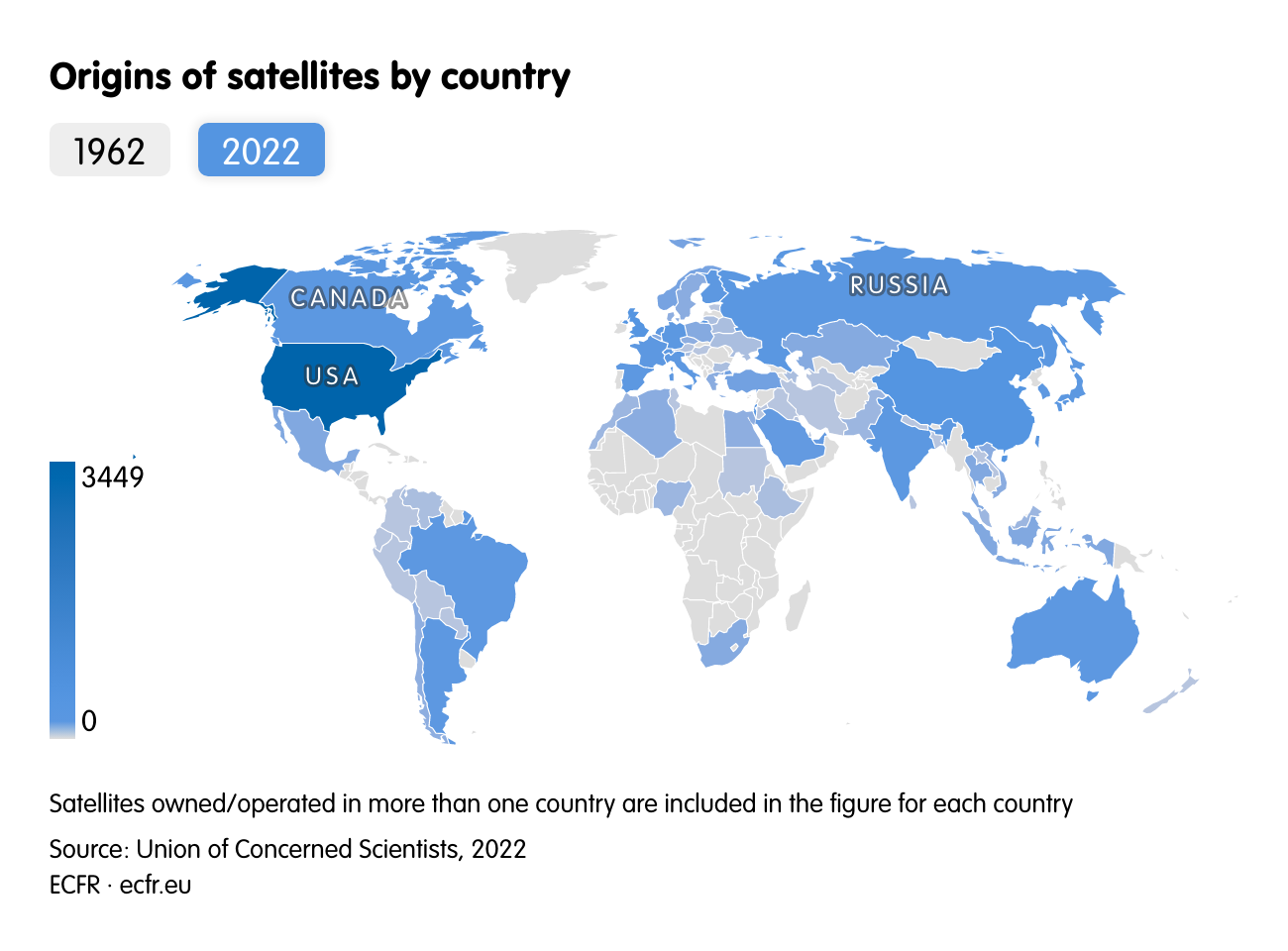
The number of actors declaring a stake in space since the Soviet launch of Sputnik 1 in 1957 has dramatically increased. Today, with the exception of much of sub-Saharan Africa, most countries now have satellites in orbit. Western governments in particular increasingly rely on the private sector to provide critical connectivity and sensing services, with SpaceX being just one prominent example.
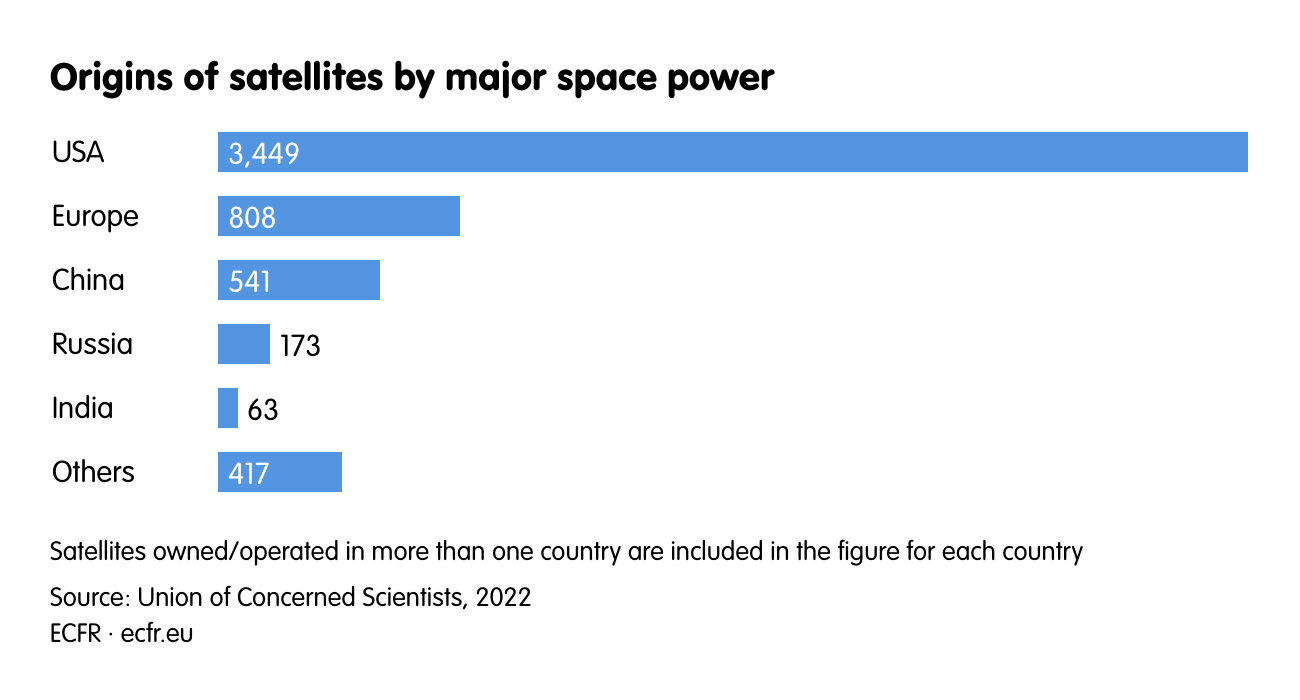
The remarkable increase also means that Western countries are no longer unique in their dependence on space-based assets for civilian and military purposes. This proliferation reduces incentives for adversaries to strike, blind, or otherwise interfere with satellites for fear of retribution: the US and Europe may still dominate in terms of overall numbers, but in 2022, China conducted 62 successful orbital launches, second only to the United States' 76 and far ahead of Europe's 6 launches.
This vast number of interests has translated into enthusiasm from governments and companies worldwide in making progress to prevent collisions and protect access to space. But geopolitical competition ensures issues around the weaponisation of the global common space are much more difficult to address.
The challenge of multilateral space governance
Information sharing and space situational awareness will become increasingly important as low Earth orbit becomes more congested and the risk of collisions grows
Despite increasing strategic competition, some multilateral institutions have been able to facilitate fruitful discussions. In 2021, the UN General Assembly established the "open-ended working group on reducing space threats through norms, rules and principles of responsible behaviours" (OEWG). The OEWG been advancing discussions among members, particularly in the areas of information sharing and space situational awareness. These will become increasingly important as low Earth orbit becomes ever more congested and the risk of collisions grows.
Bodies such as the OEWG are unlikely to produce immediate results due to the conflicting interests of the major space powers. However, they can help to define unacceptable behaviours and develop verification mechanisms. Progress to date should encourage the EU and interested partners to continue advancing the development of these norms, even if a consensus document remains some way off. Existing frameworks to prevent hazardous incidents at sea or limit the proliferation of ballistic missiles could provide inspiration.
Russia's aggression against Ukraine led to a new sense of transatlantic unity. This was mirrored in European support for a US-led initiative to ban destructive ASAT weapons testing. On 7 December 2022, 155 nations – including all EU member states – supported a non-binding resolution on the ban at the UN General Assembly. Nine countries – Belarus, Bolivia, the Central African Republic, China, Cuba, Iran, Nicaragua, Russia, and Syria – objected; another nine, including India, abstained. Of these 18 countries, only Madagascar and Serbia were among the 141 UN members demanding that Moscow "immediately, completely and unconditionally withdraw all of its military forces from the territory of Ukraine" on the eve of the one-year anniversary of Russia's aggression in February 2023. This anti-Western coalition, with Russia and China at its centre, shows some cohesion, but its relatively small size also suggests that most UN members from Africa, Asia, and Latin America approach voting with more pragmatism – at least when it comes to non-binding resolutions in the General Assembly.
A friendship with(out) limits in space
Before Russia's invasion of Ukraine in 2014, Moscow had tried to keep Beijing at arm's length regarding space. Although the Kremlin welcomed cooperation on space projects, it also sought to prevent the transfer of sensitive technology that could result in the emergence of a future rival. But Western sanctions on Russia after 2014 briefly boosted Sino-Russian space cooperation: China sought Russian expertise, while Russia drew on Chinese resources.
Now the tables are turning. China is investing heavily in technology and capability development, but Russia is now a less attractive partner due to a lack of investment in its space industry, including in training new personnel. The tightening of technology and economic sanctions against Russia since February 2022 has accelerated this trend.
Other emerging space powers might conclude similarly. In December 2021, Russia and India agreed on an ambitious cooperation agenda, including in technology development for spaceflight and exploration. India has a longer way to go than China on its national space programme. But its dependence on Moscow for arms and other goods might caution against deeper cooperation at a time when the Kremlin is devoting an ever greater share of industrial capacity to service its war against Ukraine and its high-tech and aerospace sectors are buckling under Western sanctions.
But Russia's value as a diplomatic ally for China has taken less of a hit. Just as Beijing keeps backing Moscow in its war against Ukraine, the two will likely continue aligning their positions on space diplomacy to deflect international criticism of their actions. Beijing voiced no criticism of Russia's ASAT test, even though it caused a near miss of a piece of debris with a Chinese satellite. When a Chinese rocket body had fallen back to Earth uncontrollably a few months prior, Moscow kept similarly quiet.
Since 2008, Russia and China have been pushing for a Treaty on the Prevention of the Placement of Weapons in Outer Space (PPWT). The EU, its member states, and other mostly Western states object to the draft on the grounds that it "does not constitute a sufficient basis for an effective, comprehensible and verifiable instrument". They also argue that Moscow's and Beijing's actions, including their development of weapons for use against targets in space, run counter to the principles of the treaty.
Nevertheless, of the 155 nations who supported the US-initiated resolution to ban ASAT weapons testing in December 2022, 95 also backed a resolution welcoming the PPWT draft, including many African, Asian, and Latin American countries. These countries seem to support initiatives to mitigate space threats regardless of where they originate. For the EU and its allies this is a problem as much as it is a call to action: no one is waiting for the West to lead them; but at the same time, a Western invitation towards these countries for genuine co-ownership of the future space order would be welcome.
Legally binding international mechanisms to address threats to space remain a long way off. But space will only grow in importance for the EU's commercial, scientific, and security interests. For the EU's new space strategy and proposed space law to be successful, Europeans will need to build on the OEWG process. That way, the EU's regulatory gravitas could lead others to align their approaches to mitigating space threats and risks, and preserve space as a global common.
The European Council on Foreign Relations does not take collective positions. ECFR publications only represent the views of their individual authors.







No comments:
Post a Comment