McCabe Library is my favorite library on campus. It is large, comfortable, and has all of the fiction, as well as non-fiction books about art, economics, government, language, and every other humanities subject (excluding music).
One day, as a friend and I were musing on the quite frankly ridiculous size of Who's Who in the People's Republic of China (1981), she idly wondered what some of the outliers for size in our library were. After all, we have a truly ridiculous number of books; surely, there must be some interesting proportions. After a thorough investigation, here are the conclusions to this pressing research question.
SMALLEST
The smallest book found (admittedly, a category harder to look for than largest) is a pocket edition of La Venganza de Don Mendo by Pedro Muñoz Seca, a Spanish satire about a court of nobles meeting their demise at each other's hands after a scandalous affair. It is adorably small—perfect to bring in your pocket on the day of a picnic and read aloud to your dadaist satirist Spanish-speaking friends (of whom, bizarrely enough, I have two).
THINNEST
The award of thinnest book goes to An Introduction to the Literature of Chemistry by F. A. Mason, a 1925 list of papers deemed essential for the budding chemist. Well less than a quarter inch wide, it is described as "a relief" and "well needed" in the introduction, and "unsatisfactory" and "[needing] advice from specialists" in a particularly unhappy review in a 1925 Nature magazine. Though interesting, a guide where well over half the papers were written before our current understanding of the atom was developed will likely not prove of much use to today's aspiring chemists. Bizarrely, the only physical version of this book available for purchase is a $40 leather-bound edition through the Walmart website. If you do not wish to pay that, come down to McCabe!
THICKEST
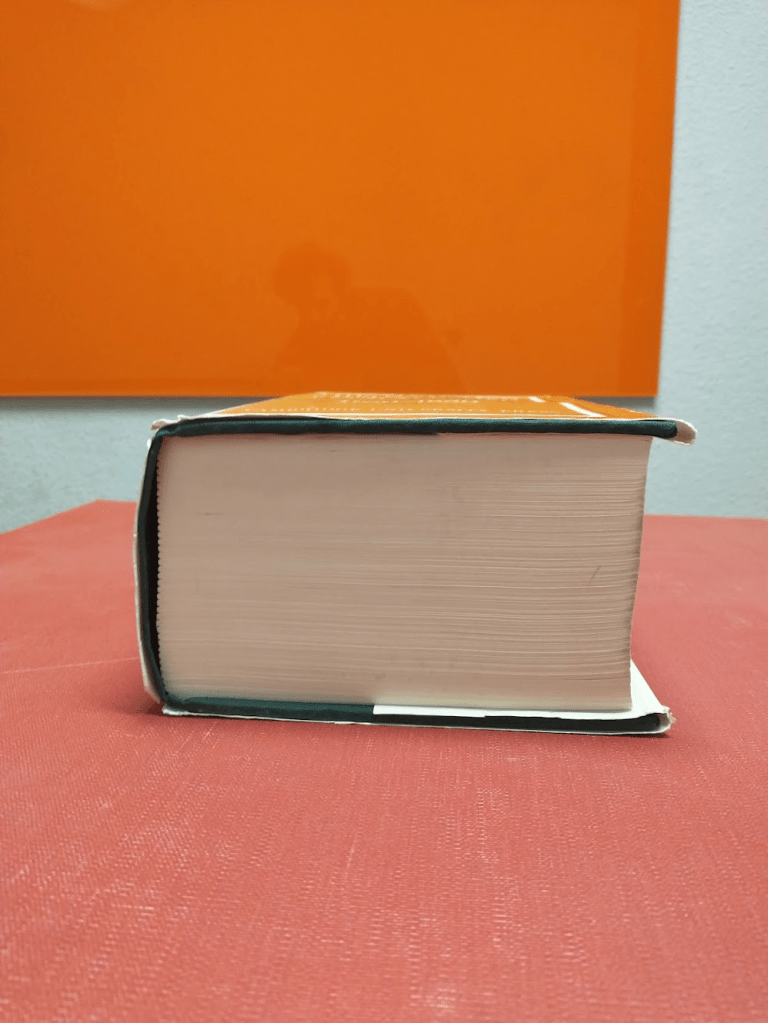
The much-coveted award for thickest goes to Volume VI of The Agrarian History of England and Wales. A terrifyingly thorough piece of research, it covers the history of agriculture through the industrial revolution in England. With entire chapters dedicated to the "Malting Industry," it is a riveting page-turner.
It is surprisingly readable for a work of scholarship of this depth; I (not an expert on the British malting industry) was able to comprehend everything it was saying with helpful footnotes, and am now quite impressed by the scope of said malting industry. If one needs more agricultural tables after finishing, they can go to the prequels, the almost-as-wide volumes I-V.
HEAVIEST
Heaviest goes to the gorgeous The Grand Medieval Bestiary by Christian Heck and Rémy Cordonnier. It is a collection of and analysis of animals in illuminated manuscripts. It is quite obvious when the illustrator has never actually seen the animal they are drawing. Due to the high-quality printing of thousands of pictures, it is astonishingly heavy. Reading it, I can see myself as a monk in a monastery, except I am in Kohlberg Cafe and doodling a Calvin and Hobbes parody comic.
TALLEST
The Acme Novelty Library, by Chris Ware, holds the award for tallest. A graphic novel experimenting with form and structure, this was the only one of these books I read all the way through, and I am so incredibly glad I did. Flashing back and forth between the past and present, it is about many, many things, but loosely chronicles the lives of Rusty Brown and Chalky White—first as two awkward, superhero-obsessed elementary schoolers, and later as adults. Chalky has moved on and is struggling through family life, while Rusty has become a desperate and obsessed action figure collector, living with his mother, unable to drive or cook or live without her support, depending on her and Chalky emotionally and materially, as his life comes apart in pieces.
It's a wonderfully drawn, often brutal, and always a hilarious read. This list is a joke, but this recommendation is not.
LET'S GET WILD: REFERENCE BOOKS INCLUDED
Allowing reference books onto this list is like allowing anabolic steroids at the olympics; arguably cheating, but it makes them much more interesting. There were a few that were too ridiculous not to include.
HEAVIEST
A staggering folio of incredible effort, Audubon's Birds of America by Roger Tory Peterson and Virginia Marie Peterson takes the title for overall heaviest. Though not the largest (even our comic book is taller than it), its hundred of gorgeously-engraved drawings weigh it down. It is depressingly heavy, weighing about as much as ~3 bricks (no scale was on hand)—a terrific coffee-table book.
LARGEST OVERALL:
Opposite that, perhaps the worst coffee-table book ever invented, Corpus Inscriptionum Latinum VI, Pars VII, Fasc. III takes the award for the overall largest single volume in our libraries. I could not get a photograph to properly capture its size, but, needless to say, it is obscene. A small part of an incredibly ambitious collection of every single Latin inscription from the Roman Empire, the Swarthmore McCabe library has the entirety of volume VI, all inscriptions from the city of Rome itself. The book is printed entirely in some sort of Courier-esque font and is completely incomprehensible to those who cannot speak Latin (and, having asked, not exactly clear to those who can). Larger than any dictionary, this book takes the place for largest volume in McCabe.
Or, it would.
If not for the fact that…
BIG REVEAL: THE TABLE I'VE BEEN DISPLAYING THESE ON IS ALSO A BOOK
To visit the final frontier, we must go to government documents. These are books printed without regard for marketability or cost—just pure archival purpose. And here, we find our true and final winner, the world champion, 1960 U.S. Census of Housing, Vol. III: City Blocks, Map Supplements.
This book is roughly the size of a standard Willets-dorm washing machine. It contains the district/borough maps for many cities across the United States. Every map is drawn to a similar scale, so every page has a radically different size. Some are almost normal sized—8.5"x11"—and some are fold-outs so large that even the most massive of the government printing presses cannot hold them, and they are folded inside to pounce on an unsuspecting urbanologist.
If there is something beyond this lurking in our stacks, I don't want to know about it. I'm scared.




No comments:
Post a Comment